How Long Are Hockey Games? A Clear Guide to Game Time
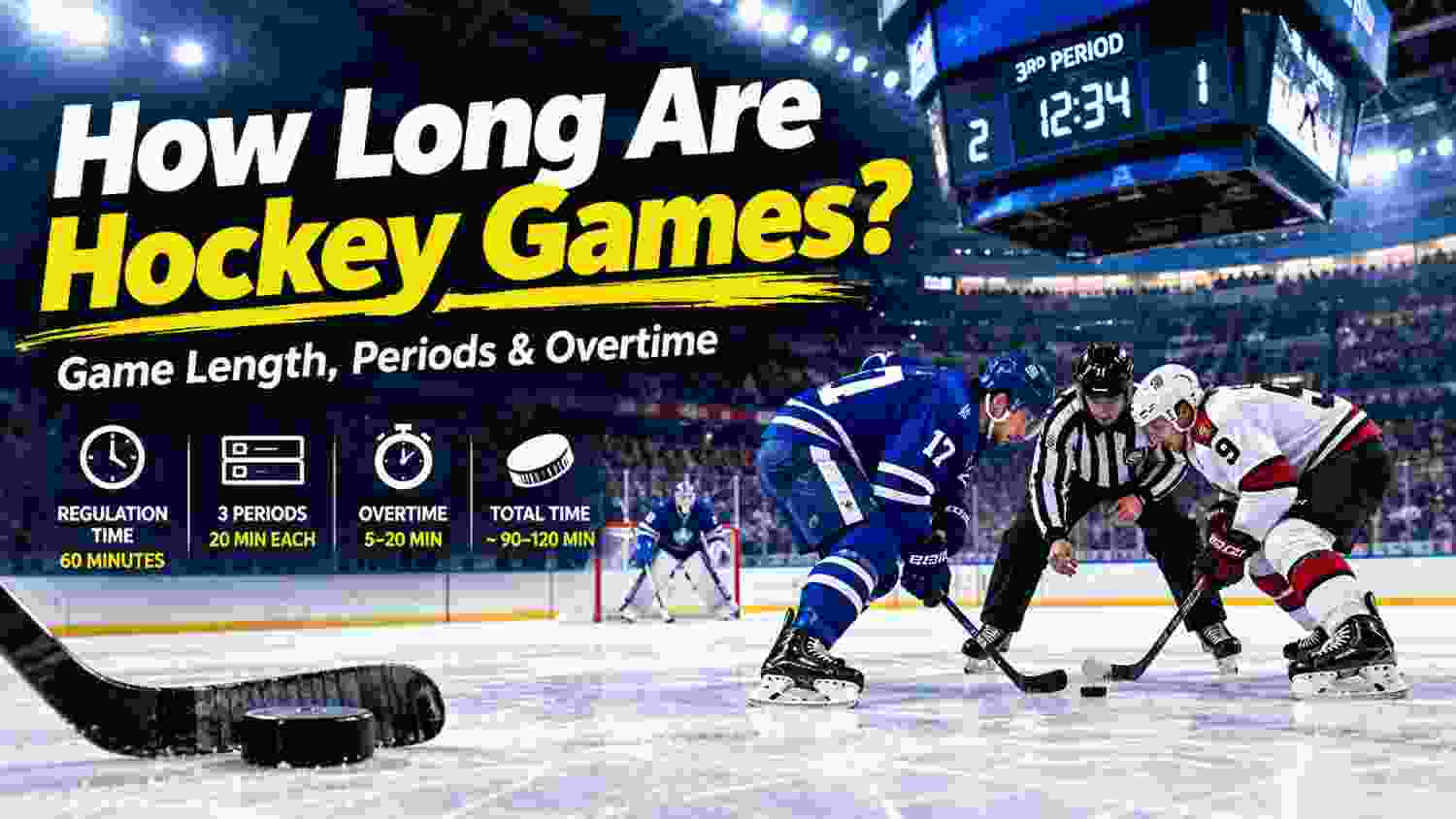
A hockey game has 60 minutes of scheduled regulation play, but the event lasts much longer. Stoppages, three periods, intermissions, reviews, penalties, and overtime can stretch a professional game to about two and a half hours. The exact schedule depends on the league, age group, venue, and whether the score is tied.
how long are hockey games?
Most professional hockey games take about 2 to 2.5 hours from opening faceoff to the final horn. Regulation contains three 20-minute periods, not one uninterrupted hour. Add two intermissions, stoppages, television breaks, reviews, and possible overtime, and the clock on your evening looks very different from the game clock.
| Game type | Regulation play | Typical event length | What can extend it |
| NHL regular-season game | 60 minutes | About 2 to 2.5 hours | Stoppages, intermissions, overtime, shootout |
| NHL playoff game | 60 minutes | About 2.5 to 3+ hours | Sudden-death overtime periods |
| International game | 60 minutes | About 2 to 2.5 hours | Competition rules, overtime, shootout |
| College game | 60 minutes | About 2 to 2.5 hours | Intermissions and overtime format |
| Youth or amateur game | Often shorter | About 1 to 2 hours | Age rules, ice-time limits, tournament schedule |
The simple time breakdown
To understand how long are hockey games in practice, separate playing time from elapsed time. The scoreboard counts active time during each period. It stops after whistles, goals, penalties, offsides, icing, injuries, timeouts, and video reviews.
| Part of the event | Typical duration | Does it count as playing time? |
| First period | 20 minutes | Yes |
| First intermission | Around 15–18 minutes | No |
| Second period | 20 minutes | Yes |
| Second intermission | Around 15–18 minutes | No |
| Third period | 20 minutes | Yes |
| Regulation total | 60 minutes | Yes, combined |
| Overtime or shootout | Varies | Extra time after a tie |
The two intermissions alone can add roughly 30 to 36 minutes. Normal stoppages add more, which explains why a game with only 60 minutes of regulation action rarely ends exactly one hour after it begins.
Why the game clock does not tell the whole story
Hockey uses a stop-time clock. The clock stops when the referee blows the whistle.It restarts when the official drops the puck for the next faceoff or play resumes.
That system protects fair playing time, but it creates many pauses for viewers. Common stoppages include:
- The puck leaving the playing surface
- Offside or icing calls
- A goal and the ensuing faceoff
- A penalty call
- A team timeout
- An injured player receiving attention
- A television or commercial break
- A coach’s challenge or official review
- Equipment problems or ice repairs
A fast game may finish near the shorter end of the range. A game with many penalties, goals, reviews, or injuries may last longer. Those differences matter when planning transport, childcare, dinner, or a postgame event.
How long are NHL hockey games?
An NHL game has three 20-minute periods, so regulation lasts 60 minutes. In a typical regular-season contest, fans should plan for approximately two hours and 20 minutes to two hours and 40 minutes from the opening faceoff to the final whistle. The exact time changes with stoppages and the building’s operations.
| NHL situation | Extra format after regulation | Practical planning estimate |
| Regulation win | None | About 2–2.5 hours |
| Regular-season tie after 60 minutes | Five-minute sudden-death overtime | About 2.5 hours or more |
| Tie after regular-season overtime | Shootout | Often adds several minutes |
| Stanley Cup Playoff tie | Repeated 20-minute sudden-death periods | Could run well beyond 3 hours |
The NHL’s official explanation states that regular-season overtime uses five minutes and three skaters per side, followed by a shootout if necessary. Stanley Cup Playoff games continue with 20-minute sudden-death periods until a team scores.
How long are hockey games during the playoffs?
Playoff games can last much longer than regular-season games because a tied contest cannot end in a shootout. Teams play another full sudden-death period after an intermission. If neither team scores, they repeat the process.
| Playoff stage | If tied after regulation | Possible result |
| NHL postseason | 20-minute sudden-death period | First goal wins |
| After one overtime | Another intermission and 20-minute period | Continues until a goal |
| Multiple overtime game | Additional 20-minute periods | No fixed upper limit |
A playoff audience should avoid booking a tight connection immediately after the game. The final horn may come quickly, or the teams may remain on the ice for hours beyond the scheduled finish.
How long are college hockey games?
College hockey also uses three 20-minute periods, giving it 60 minutes of regulation. A college event commonly takes around two to two and a half hours, although the result depends on the conference, tournament, and venue schedule.
Overtime rules deserve special attention. NCAA competition has used different formats for regular-season games, conference play, tournaments, and postseason events. The NCAA has described a five-minute overtime followed by different options depending on the competition, including a shootout or longer sudden-death play.
| College game detail | What to expect |
| Regulation | Three 20-minute periods |
| Intermissions | Usually longer than a quick period break because the ice may need care |
| Tied regular-season game | Check the event’s published overtime policy |
| Tournament game | May require a winner and use extended sudden death |
| Best planning choice | Allow at least 2.5 hours |
Always check the host school’s game notes when a tournament or championship is involved. The same sport can have different tie-breaking procedures across competitions.
How long are international hockey games?
International hockey generally follows the same core structure: three 20-minute periods with intermissions. The IIHF rule book describes 60 minutes of regulation and 15-minute intermissions, while individual events can publish different operational details.
The IIHF’s 2026 Olympic tournament information lists three 20-minute periods and an 18-minute intermission. It also sets a five-minute overtime for a preliminary-round tie, while later knockout games can use longer overtime.
| International setting | Regulation | Tie procedure may include |
| Group or preliminary game | 60 minutes | Short sudden-death overtime and shootout |
| Knockout game | 60 minutes | Longer overtime and, in some events, a shootout |
| Gold-medal game | 60 minutes | Repeated sudden-death overtime until a winner |
The tournament rules matter more than a general estimate. If you are attending an Olympic, world championship, or national-team game, read that event’s schedule and overtime format before making travel plans.
How long are youth hockey games?
Youth hockey is not one uniform product. Leagues change period length and game limits by age, skill level, rink availability, and local association rules. Younger players often play shorter periods, while older youth divisions may approach the adult format.
| Youth factor | How it changes the schedule |
| Age division | Younger divisions usually use shorter periods |
| Game limit | A league may cap total time or stop the clock differently |
| Tournament rules | Back-to-back games may use a shortened format |
| Ice rental | The game may end on a hard time limit |
| Mercy rule | A large lead can change the final minutes or stop the clock |
| Overtime | Some games allow it; others accept a tie |
For a youth game, ask the organizer for the total ice slot, not only the period length. A 60-minute ice booking may include warmups, setup, and the game itself, leaving less time than the adult format suggests.
Why warmups and arena time add to the visit
The game length does not include everything surrounding the event. Teams usually warm up before the opening faceoff, and spectators may spend time entering the arena, finding seats, buying food, or waiting for traffic to clear.
| Planning stage | Suggested allowance |
| Parking, security, and entry | 20–45 minutes |
| Finding a seat and concessions | 10–20 minutes |
| Pre-game warmup | Often begins before the listed start |
| Game itself | About 2–2.5 hours for many adult games |
| Exit and traffic | 15–45 minutes |
For a major professional game, reserve four hours door to door when parking and postgame traffic matter. Arriving 30 to 45 minutes early gives you room for security lines and lets you watch warmups without rushing.
What happens during each period?
Each period begins with a faceoff and ends when the clock reaches 0:00. The teams change ends between periods. Players leave the ice during intermissions while crews tend the playing surface and spectators reset for the next section of action.
| Period | Main features |
| First | Teams settle into the game; early penalties and line changes shape the pace |
| Second | Teams attack in the opposite direction; fatigue and matchups become important |
| Third | The score creates urgency; stoppages often increase late in a close game |
| Overtime | Fewer skaters or sudden-death rules may create open ice |
| Shootout | Selected players take attempts to settle a tied game |
The 20-minute period is a fixed rule in many senior competitions, but the real-world duration depends on how often officials stop play and how much commercial or review time the broadcast uses.
How overtime changes the finish time
Overtime can add only a few minutes, or it can turn a normal evening into a long one. The format depends on the league and event. A short sudden-death period may end with the first goal. If no one scores, a shootout or another overtime period follows.
| Overtime type | Description | Effect on your schedule |
| Sudden death | The first goal ends the game | Could be very brief |
| Five-minute overtime | A limited extra period | Adds the play plus a short break |
| Ten-minute overtime | Used in some competitions | Creates a longer finish window |
| Twenty-minute overtime | Common in high-stakes playoff settings | May repeat several times |
| Shootout | Alternating attempts decide the winner | Usually adds a short final segment |
A shootout is not the same as another full period. It uses selected shooters and goalkeepers, so it can settle a game quickly. Playoff sudden death has no comparable fixed endpoint.
How penalties, reviews, and goals affect duration
A penalty stops the clock and sends a player to the penalty box. The power play may create several whistles, but the penalty itself does not automatically add a set amount to the game’s elapsed time. The same principle applies to goals: the clock stops for the goal announcement and faceoff, then play resumes.
Video reviews can create a longer pause because officials need time to inspect footage and communicate a decision. An injury, broken glass, or ice problem can extend the break even further.
| Event | Why it takes time |
| Penalty | Officials report the call and set the next faceoff |
| Goal | Officials confirm the goal, record it, and reset play |
| Review | Officials inspect footage before announcing a decision |
| Injury | Medical staff need safe access to the player |
| Broken glass | The rink crew must make the surface safe |
| Too many stoppages | The cumulative pauses make the game run long |
This is why a scoreless game can still last longer than a high-scoring game. The number of whistles and reviews matters as much as the number of goals.
How to plan around a hockey game
Use the listed start time as the beginning of the event, not the time you should arrive. A simple schedule prevents avoidable stress.
- Arrive 30 to 45 minutes early. Add more time for a large arena, security screening, or difficult parking.
- Allow at least 2.5 hours for the game. This covers most adult games without a long overtime.
- Add 30 to 60 minutes for travel out. Traffic often builds immediately after the final horn.
- Avoid a tight appointment afterward. Close playoff games can continue far beyond regulation.
- Check the event rules. Tournament overtime can change the expected finish.
- Dress for the rink. Indoor arenas often feel colder than the weather outside.
If you need to catch a train, flight, or bus, leave a generous buffer. A game may finish in regulation, but no schedule can promise that result in advance.
Keyword placement question: how long are hockey games?
Answer: Most adult hockey games last about two to two and a half hours in total. They contain 60 minutes of regulation play, two intermissions, and stoppages. Overtime, a shootout, reviews, injuries, and playoff rules can make the event longer.
This answer applies best to professional, college, and international games. Youth hockey needs a league-specific estimate because period length and time limits vary by age group.
Frequently asked questions
1. How long are hockey games in minutes?
Most adult games take about 140 to 160 minutes from faceoff to final whistle. Regulation itself lasts 60 minutes, while intermissions and stoppages account for the rest.
2. Is a hockey game really 60 minutes long?
Only the regulation playing time is 60 minutes. The event lasts long because the clock stops during whistles and the teams take intermissions between periods.
3. How long are hockey games on TV?
A televised adult game usually occupies about two and a half hours, including broadcasts, breaks, and postgame coverage. A close game or overtime can extend the program.
4. How long are hockey games if they go to overtime?
A regular-season overtime may add a few minutes plus a short break. A playoff game can add one or more full 20-minute sudden-death periods, so there is no dependable maximum finish time.
5. How long are hockey games for children?
Many youth games last one to two hours, but the answer depends on age, league rules, ice time, warmups, and tournament limits. The organizer’s schedule provides the safest estimate.
6. Should I arrive early for a hockey game?
Yes. Arrive 30 to 45 minutes before an adult game, and allow extra time for security, parking, tickets, and seating. You may also see warmups before the opening faceoff.
Final takeaway
So, how long are hockey games? For most adult games, plan on roughly two to two and a half hours, then add extra time for overtime and your journey home. Check the league’s rules, arrive early, and keep your schedule flexible when a playoff or tournament game must produce a winner.
Once you know the difference between regulation time and the full event, watching hockey becomes easier to plan. If a friend asks how long are hockey games, you can give a useful answer instead of quoting the 60-minute game clock. Bring the right layers, choose a comfortable arrival window, and stay for the final horn—some of the sport’s best moments happen after the clock seems ready to end the night.
🎮 Want More Guides?
Explore more tips, codes, patches and gaming guides in our Blog Arena.
▶ Browse All Quests