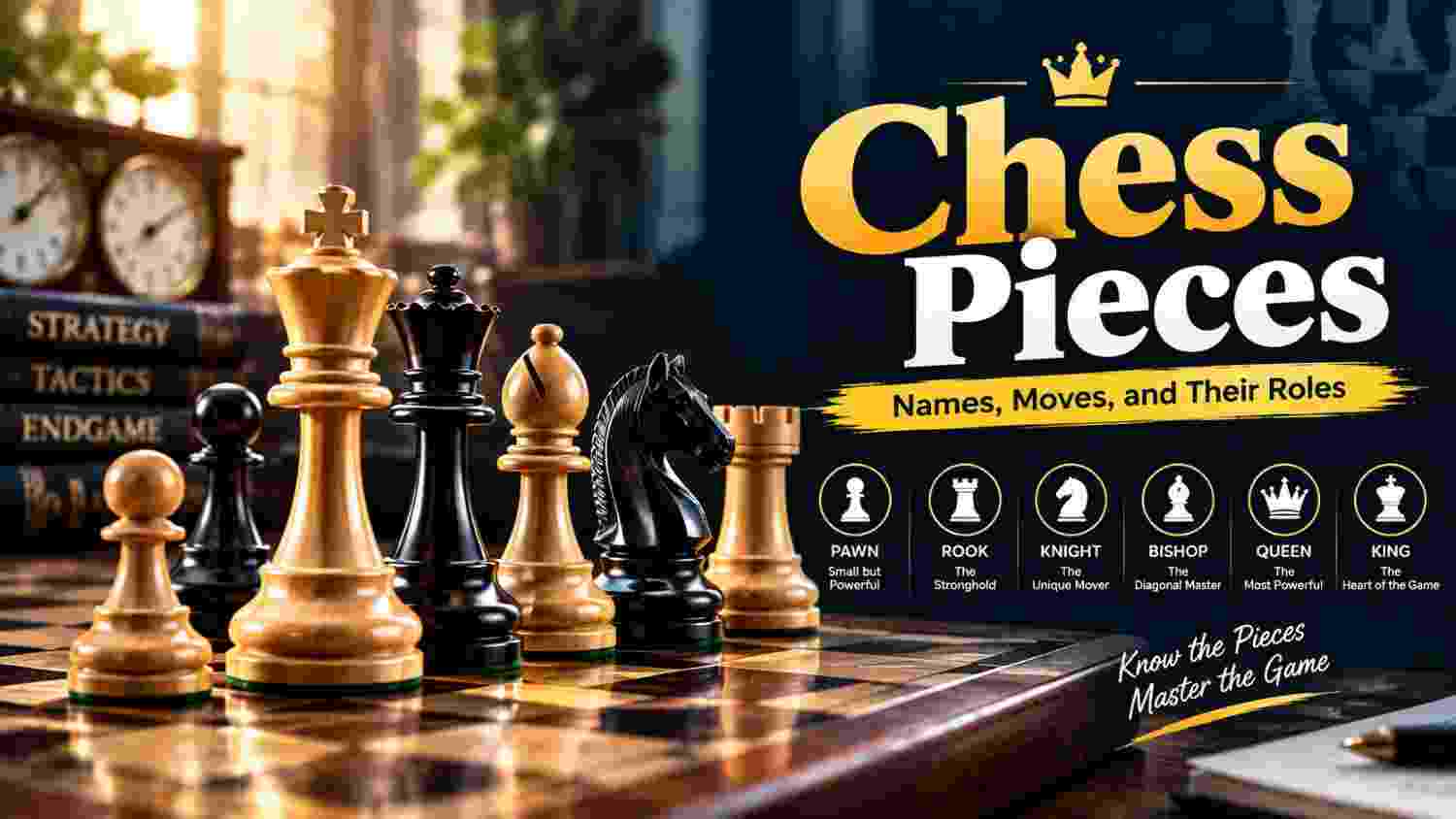
Chess Pieces: The Complete Guide to Names, Moves, and Values
You sit down to play but freeze because you cannot remember how each piece moves. Mixing up the bishop and knight costs you games and confidence every single time. This guide breaks down every chess pieces by name, movement, and point value so you never second-guess a move again and start winning with real understanding.
What Are Chess Pieces and How Many Do You Need?
A standard chess set contains 32 chess pieces split evenly between two players. Each side commands 16 units: one king, one queen, two rooks, two bishops, two knights, and eight pawns.
These chess pieces sit on a 64-square board arranged in an 8×8 grid. The player controlling white always moves first, which grants a slight tempo advantage from the very first turn.
Understanding each unit’s role transforms you from a casual mover into a strategic thinker. The World Chess Federation (FIDE) governs the official laws that define how every piece behaves during competitive play.
The King: Your Most Important Chess Piece
The king moves one square in any direction — horizontally, vertically, or diagonally. Despite this limited range, the king holds infinite value because losing it ends the game immediately.
Protecting your king drives every strategic decision you make on the board. When an opponent attacks your king and no legal escape exists, the game ends in checkmate.
During the endgame phase, the king becomes an active attacker. Strong players push their king toward the center once most heavy units leave the battlefield.
The Queen: The Most Powerful Chess Piece on the Board
The queen combines the movement of the rook and bishop into one devastating unit. She slides any number of squares along ranks, files, and diagonals without restriction.
This freedom makes the queen worth nine points — the highest value of any standard piece. Losing your queen early often decides the game before the middlegame even begins.
New players frequently rush the queen out too fast. Experienced players develop minor pieces first and activate the queen only after the board opens up naturally.
The Rook: The Castle That Controls Open Files
Each player starts with two rooks placed in the far corners of the board. A rook moves any number of squares horizontally or vertically but cannot jump over other units.
Rooks thrive on open files — columns with no pawns blocking the path. A pair of rooks stacked on the same file, known as “doubled rooks,” creates enormous pressure against the opponent’s position.
The rook earns five points in the standard valuation system. This value climbs sharply in the endgame when fewer units clutter the board and open lines multiply.
The Bishop: The Diagonal Specialist
Bishops glide along diagonals for any number of unobstructed squares. Each player begins with two bishops: one permanently locked to light squares and one locked to dark squares.
This color-bound restriction means a single bishop can only ever reach half the board. The bishop pair, however, covers all 64 squares and often outperforms a bishop-knight combination in open positions.
A bishop scores three points, the same as a knight. Choosing between keeping a bishop or a knight depends heavily on pawn structure and whether the position stays open or closed.
The Knight: The Only Chess Piece That Jumps
The knight moves in an “L” shape: two squares in one direction and then one square perpendicular. This unique pattern lets the knight leap over any unit standing in its path.
That jumping ability makes the knight deadly in closed positions where pawns block bishops and rooks. A knight planted on a central outpost — a square protected by a pawn and unreachable by enemy pawns — can dominate the entire board.
Knights also deliver fork attacks more effectively than any other unit. A well-timed knight fork can simultaneously attack the king and queen, forcing your opponent to sacrifice material.
The Pawn: The Soul of Chess Strategy
Pawns move forward one square at a time but capture diagonally. On their first move, pawns may advance two squares, which creates the special en passant capture rule.
Though worth only one point, pawns shape the entire structure of the game. The 18th-century master François-André Danican Philidor famously called pawns “the soul of chess” because their placement dictates piece activity and king safety [Source: World Chess Hall of Fame, worldchesshof.org].
Pawn chains, passed pawns, and pawn islands all influence long-term plans. A single passed pawn racing toward promotion can decide an otherwise equal endgame.
Chess Piece Values: A Complete Point System
Knowing the point value of each unit helps you evaluate trades quickly during a game. The United States Chess Federation teaches the following standard valuation to players at every level [Source: US Chess Federation, uschess.org].
| Chess Piece | Quantity Per Side | Point Value | Movement Summary |
| King | 1 | ∞ (Infinite) | One square in any direction |
| Queen | 1 | 9 | Any squares along ranks, files, and diagonals |
| Rook | 2 | 5 | Any squares along ranks and files |
| Bishop | 2 | 3 | Any squares along diagonals only |
| Knight | 2 | 3 | L-shape pattern; jumps over obstacles |
| Pawn | 8 | 1 | One square forward; captures diagonally |
Use this table as a quick reference during your games. Remember that positional factors can shift these values — a trapped bishop may be worth far less than an active knight.
How Do Chess Pieces Move? A Quick Breakdown
Every chess piece follows a fixed movement pattern that never changes during the game. Here is a rapid summary you can memorize in under two minutes:
- King: One square in any direction.
- Queen: Unlimited squares along straight lines and diagonals.
- Rook: Unlimited squares along straight lines only.
- Bishop: Unlimited squares along diagonals only.
- Knight: Two squares plus one square at a right angle; jumps over obstacles.
- Pawn: One square forward (two on the first move); captures one square diagonally forward.
No chess piece can move through a square occupied by a friendly unit. Capturing happens when a piece lands on a square held by an enemy unit.
Chess Piece Setup: Where Does Each Unit Go?
Correct placement at the start of the game prevents embarrassing mistakes. Follow this simple setup rule: “White on right” means the bottom-right corner square must be a light color.
Place the units on the first two rows closest to you:
- Back row (left to right): Rook, Knight, Bishop, Queen, King, Bishop, Knight, Rook.
- Front row: All eight pawns in a straight line.
The queen always starts on her own color — the white queen on a light square and the black queen on a dark square. This simple rule eliminates the most common setup error beginners make.
Special Chess Piece Rules You Must Know
Three special rules involve unique interactions between chess pieces and often confuse new players.
Castling lets the king move two squares toward a rook while the rook jumps to the opposite side of the king. This maneuver requires that neither unit has moved previously, no pieces stand between them, and the king does not pass through check.
En passant allows a pawn to capture an enemy pawn that just advanced two squares and landed directly beside it. You must execute this capture on the very next move or lose the right permanently.
Pawn promotion occurs when a pawn reaches the farthest rank. The pawn transforms into any piece except a king — most players choose a queen for maximum firepower.
Common Chess Piece Mistakes Beginners Make
Trading a bishop and knight for a rook and pawn sounds even on paper but usually favors the side keeping the two minor pieces. Two active units coordinate better than one rook in most middlegame positions.
Moving the queen too early invites tempo-gaining attacks from your opponent’s minor units. Develop knights and bishops first, castle your king to safety, and then activate the queen.
Ignoring pawn structure creates long-term weaknesses that stronger players exploit ruthlessly. Doubled pawns, isolated pawns, and backward pawns all become easy targets in the later stages of the game.
🎮 Want More Guides?
Explore more tips, codes, patches and gaming guides in our Blog Arena.
▶ Browse All Quests
One Comment