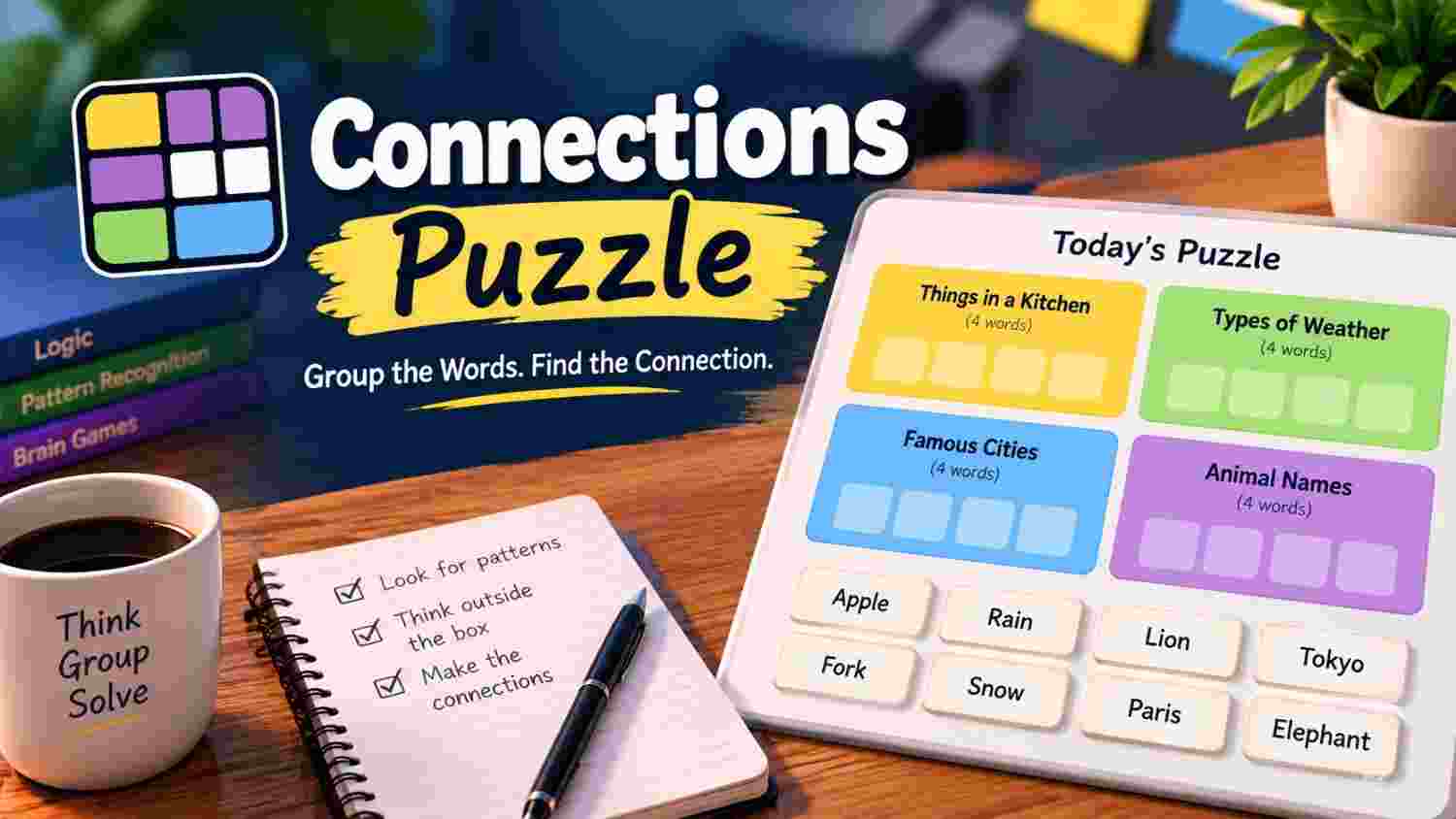
Connections Puzzle: How to Crack Every NYT Category
Connections Puzzle: How to Crack Every NYT Category
You stare at sixteen random words. Nothing clicks. Mistakes pile up fast, and frustration takes over completely. The connections puzzle looks simple until hidden traps appear in every row. This guide breaks down exact strategies, category patterns, and daily habits that turn confusion into four clean groups — starting with your very next grid.
What Is the Connections Puzzle and Why Do Millions Play It?
The connections puzzle is a daily word-grouping game published by The New York Times. Players sort sixteen words into four secret categories of four words each. Wyna Liu, a puzzle constructor at the NYT, designed the game to test lateral thinking and word association skills.
Since its launch in June 2023, the connections puzzle has attracted millions of daily players worldwide. The game sits alongside Wordle and the Mini Crossword inside the NYT Games app. Its blend of vocabulary challenge and pattern recognition keeps people returning every single morning.
How Does the Connections Puzzle Actually Work?
Each day, the New York Times releases a fresh grid of sixteen words. Your task is to find four groups of four words that share a hidden link. The links range from straightforward synonyms to sneaky wordplay that requires creative thinking.
Before the game is over, you can make four blunders.Each correct group disappears from the board and reveals its color-coded difficulty level. The connections puzzle rewards players who spot subtle relationships rather than obvious surface meanings.
What Are the Four Color Categories in the Connections Puzzle?
The game uses a color system to signal difficulty. Yellow marks the easiest group, while purple marks the hardest. Green and blue sit in the middle, offering moderate challenges that still trip up experienced players.
| Color | Difficulty Level | Typical Category Type | Example Theme |
| Yellow | Straightforward | Direct synonyms | Words meaning “happy” |
| Green | Moderate | Shared real-world context | Items found in a kitchen |
| Blue | Tricky | Wordplay or compound words | Words that follow “sun” |
| Purple | Hardest | Abstract or hidden links | Words containing silent letters |
Understanding this color system helps you prioritize which groups to tackle first when playing the connections puzzle each day.
How Do You Start Solving a Connections Puzzle Each Morning?
Begin by scanning all sixteen words before making any selections. Look for obvious clusters — words that clearly belong together jump out quickly. Lock in the easiest group first to shrink the board and reduce mental clutter.
Next, read each remaining word aloud. Hearing the words activates different parts of your brain and often reveals hidden connections. This simple habit separates casual players from those who consistently solve the connections puzzle without errors.
What Makes the Connections Puzzle So Tricky for Most Players?
The biggest trap is overlapping categories. The puzzle designers intentionally place words that fit into more than one group. A word like “bark” could belong to a tree category or a dog category, and choosing wrong costs you a life.
Red herrings appear in almost every daily grid. Five words might seem to share a theme, but only four actually belong together. The connections puzzle punishes hasty guesses and rewards patience above raw vocabulary size.
Which Proven Strategies Help You Solve the Connections Puzzle Faster?
- Shuffle the board to break visual patterns your brain already locked onto.
- Group by part of speech first — nouns, verbs, and adjectives often cluster together.
- Look for compound word halves like “fire” waiting for “fly” or “work.”
- Save the purple category for last because it demands the most abstract thinking.
- Use the “one away” hint wisely when the game tells you that you almost have a group.
Applying even two of these strategies will noticeably improve your daily connections puzzle performance within a week.
How Does the Connections Puzzle Compare to Wordle?
Wordle asks you to guess a single five-letter word in six tries. The connections puzzle asks you to sort sixteen words into four groups with only four mistakes allowed. Both games live inside the NYT Games ecosystem and reset at midnight Eastern Time.
Wordle tests spelling and letter-frequency knowledge. The connections puzzle tests semantic reasoning, word association, and the ability to resist misleading patterns. Many players enjoy both games as a morning brain warm-up routine.
What Common Mistakes Do Players Make in the Connections Puzzle?
Most beginners rush to submit their first instinct. They see four words that look related and tap “Submit” without checking whether a fifth word also fits. This oversight burns a mistake instantly.
Another frequent error is ignoring word forms. A word like “ring” could mean a piece of jewelry, a phone sound, or a boxing arena. The connections puzzle hides its best tricks inside these multiple meanings, so always consider alternate definitions before committing.
How Can Beginners Improve at the Connections Puzzle Quickly?
Start by playing every single day without skipping. Consistency trains your brain to recognize the types of categories the NYT editors favor. Within two weeks, you will notice recurring themes like “types of fish” or “words before ‘ball.'”
Study past solutions on the official New York Times archive page at nytimes.com/games/connections. Reviewing completed grids teaches you how puzzle constructors think. This backward-engineering approach accelerates improvement faster than guessing alone on the connections puzzle.
Where Can You Play the Connections Puzzle Every Day?
The game lives on the NYT Games website and inside the New York Times Games app for iOS and Android. A basic NYT account gives you free access to the daily grid. A full NYT Games subscription unlocks the archive and additional puzzle types.
You can also find fan-made versions on independent websites, but the official connections puzzle from the New York Times remains the gold standard for quality and fair design. Bookmark the page, set a morning alarm, and make it part of your daily routine.
What Tools and Resources Help With the Connections Puzzle?
- NYT Games App — the official source for daily grids and personal statistics tracking.
- Connections Solver tools — third-party websites that help you verify tricky categories after you finish.
- Reddit r/nytimes — a community where players discuss daily solutions and share solving techniques.
- Merriam-Webster Dictionary (merriam-webster.com) — useful for checking alternate word definitions when a category stumps you.
These resources complement your own reasoning and help you learn from each connections puzzle you complete.
How Does the Connections Puzzle Benefit Your Brain Health?
Solving word puzzles activates the prefrontal cortex, the brain region responsible for problem-solving and decision-making. According to the American Psychological Association (apa.org), regular engagement with cognitive games supports memory retention and mental flexibility as you age.
The connections puzzle specifically strengthens your ability to categorize information quickly — a skill that transfers to everyday tasks like organizing emails or planning schedules. Playing for just ten minutes each morning provides a measurable cognitive warm-up that sharpens focus for the rest of your day.
Your Next Move Starts Tomorrow Morning
Your next connections puzzle does not have to end in frustration. You now know how the color system works, which strategies prevent wasted guesses, and where to find the best practice resources. Open the NYT Games app tomorrow morning, apply the shuffle-and-scan method, and watch your solve rate climb. Share your streak with friends and challenge them to beat your score — the best way to master any puzzle is to make it a daily habit you actually enjoy.
🎮 Want More Guides?
Explore more tips, codes, patches and gaming guides in our Blog Arena.
▶ Browse All Quests
One Comment