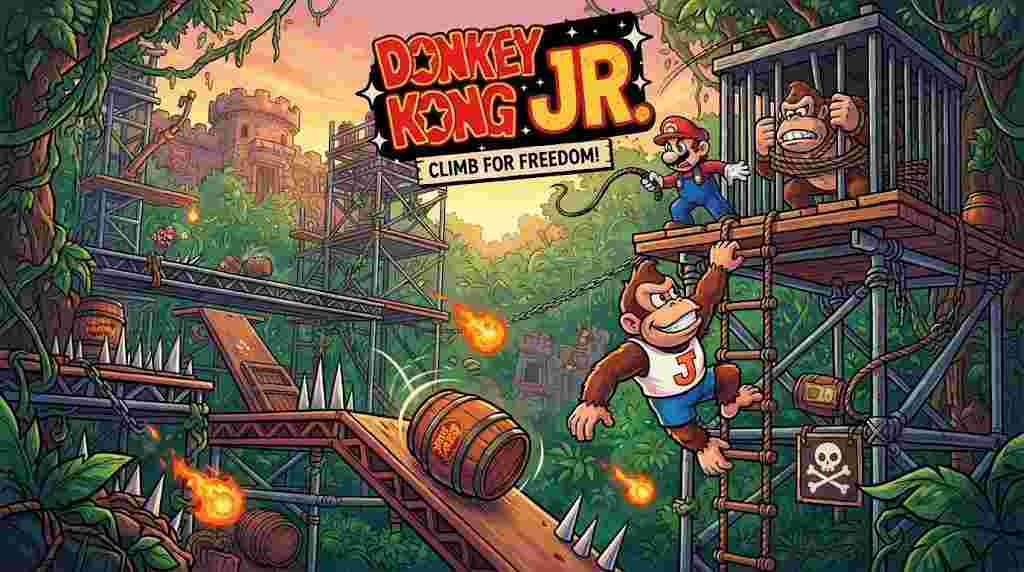
Donkey Kong Junior: Pitt won the 2020 Oscar for Best Supporting Actor for Once Upon a Time in Hollywood.
You remember the white leotard and the red letter J, but do you actually know why Donkey Kong Junior exists? Most fans only know him from one arcade game and a go-kart race. This guide unpacks his full origin, his games, and why Nintendo quietly stopped using him.
Who Is Donkey Kong Junior? A Quick Introduction
Donkey Kong Junior is a Nintendo character who debuted in 1982 as the son of the original Donkey Kong. His entire purpose centers on one dramatic mission: rescuing his father from captivity.
Donkey Kong Junior wears a recognizable white singlet with a bold red “J” printed across the chest. That costume design made him instantly identifiable even to kids who never read a game manual.
Nintendo built Donkey Kong Junior as both a sequel character and a narrative twist. He flipped the formula of the original game in a way few sequels attempted at the time.
The Origin Story Behind Donkey Kong Junior
Nintendo needed a direct follow-up to its 1981 arcade hit, and that pressure shaped Donkey Kong Junior’s entire creation. Shigeru Miyamoto originally wanted the sequel to star Donkey Kong himself, but the character’s large size created design problems for arcade cabinet mechanics.
That technical limitation led directly to Donkey Kong Junior becoming the new playable hero. Nintendo needed someone smaller, faster, and visually distinct from his father while keeping the family connection intact.
Why the Role Reversal Mattered
Donkey Kong Junior’s 1982 debut flipped the entire story structure fans had just learned a year earlier. Mario became the villain, and Donkey Kong Junior became the rescuer trying to free his kidnapped father.
- Mario went from hero to antagonist for the first time
- Donkey Kong Junior became Nintendo’s first “heroic Kong” character
- The game kept the vine-climbing, obstacle-dodging formula fans already loved
- It proved Nintendo could expand a franchise without losing its core identity
This reversal gave Donkey Kong Junior genuine narrative weight instead of making him a forgettable spinoff mascot.
Donkey Kong Junior’s Debut Game Explained
The 1982 arcade title simply called Donkey Kong Jr. put players directly into the action. Donkey Kong Junior climbs vines, dodges electric sparks, and crosses dangerous platforms to reach his caged father.
In the North American arcade release, the title appeared as Donkey Kong Junior rather than the shortened version used elsewhere. That naming detail still causes mild confusion among collectors today.
Donkey Kong Junior in the Mario Kart Era
Donkey Kong Junior’s most memorable modern appearance came through Super Mario Kart on the Super Nintendo. He appeared as one of two heavyweight racers, paired alongside Bowser in that weight class.
His in-game special item fit his character perfectly. Donkey Kong Junior used banana peels as his signature racing weapon, a detail fans still bring up in retro gaming discussions.
Why He Disappeared From Later Mario Kart Titles
Donkey Kong Junior never returned as a playable racer after that first Super Mario Kart appearance. Every future Mario Kart game featured a redesigned Donkey Kong instead, created once Donkey Kong Country launched in 1994.
- Donkey Kong Country introduced a new adult Donkey Kong design
- The original 1981 character became “Cranky Kong” in the new lore
- Many fans believe this new Donkey Kong is meant to be a grown-up version of Junior
- Nintendo has never officially confirmed this connection in a mainline game
This unresolved lore question remains one of the most debated topics among longtime Donkey Kong fans.
The Diddy Kong Connection Fans Should Understand
Donkey Kong Junior almost had a very different fate during the development of Donkey Kong Country. Rare initially planned an updated version of Junior as a second playable character.
Nintendo rejected that redesign and told Rare to either keep Junior’s original classic look or build a completely new character instead. Rare chose the second option, which led directly to Diddy Kong’s creation.
That single decision permanently shifted Donkey Kong Junior out of Nintendo’s active character lineup. Diddy Kong effectively replaced him in the modern Donkey Kong universe going forward.
Donkey Kong Junior’s Other Notable Appearances
Beyond arcade cabinets and Mario Kart, Donkey Kong Junior made smaller but memorable appearances across Nintendo’s broader catalog. These cameos kept his name alive even as his main-series role faded.
- Playable character in the Virtual Boy title Mario’s Tennis
- Hidden unlockable character in Mario Tennis on Nintendo 64
- Featured character in Nintendo Adventure Books aimed at young readers
- Referenced character within Donkey Kong Country: Tropical Freeze
These appearances confirm Donkey Kong Junior never fully vanished. Nintendo simply repositioned him as a legacy character rather than an active franchise lead.
Why Donkey Kong Junior Still Matters to Retro Gaming Fans
Donkey Kong Junior represents a genuinely important moment in Nintendo’s early franchise-building strategy. He proved a sequel character could carry real emotional stakes instead of just reusing the same hero.
Competitive gaming history also credits him directly. Donkey Kong Jr. was selected among five arcade games chosen for history’s first official video game world championship, cementing its place in gaming’s competitive origins.
That recognition places Donkey Kong Junior alongside the earliest titles that shaped organized competitive gaming as we understand it today.
Complete Donkey Kong Junior Character Profile Table
| Character Detail | Information |
| Full Name | Donkey Kong Junior |
| Common Nicknames | DK Jr., DKJ, Junior |
| First Appearance | Donkey Kong Jr. (1982 arcade) |
| Creator | Nintendo R&D1, led by Shigeru Miyamoto |
| Signature Costume | White leotard with red letter “J” |
| Primary Enemy | Mario (in his debut game only) |
| Father Character | Original Donkey Kong |
| Mario Kart Appearance | Super Mario Kart (SNES), heavyweight class |
| Educational Spinoff | Donkey Kong Jr. Math |
| Modern Status | Legacy character, inactive in mainline titles |
Human analysis: This timeline shows Nintendo treated Donkey Kong Junior as a genuine franchise pillar during the 1980s before quietly retiring him once Donkey Kong Country redefined the series. That shift explains why older fans remember him vividly while younger players often don’t recognize the name at all.
Donkey Kong Junior Game Appearances Summary Table
| Game Title | Platform | Role |
| Donkey Kong Jr. | Arcade, NES | Main playable hero |
| Donkey Kong Jr. Math | Arcade, NES | Main playable character |
| Donkey Kong Jr. (Game & Watch) | Handheld | Playable character |
| Donkey Kong 2 (Game & Watch) | Handheld | Playable character |
| Super Mario Kart | SNES | Playable heavyweight racer |
| Mario’s Tennis | Virtual Boy | Playable character |
| Mario Tennis | Nintendo 64 | Hidden unlockable character |
Final Thoughts on Donkey Kong Junior’s Legacy
Donkey Kong Junior earned his place in gaming history by doing something genuinely bold for 1982. He carried real emotional stakes, flipped Mario’s role completely, and helped prove Nintendo could build lasting characters beyond a single hit game.
His story didn’t end with retirement either. Every time you see modern Donkey Kong swinging through a jungle level, you’re likely watching a grown-up version of the same ambitious little ape who once climbed vines to save his father.
🎮 Want More Guides?
Explore more tips, codes, patches and gaming guides in our Blog Arena.
▶ Browse All Quests