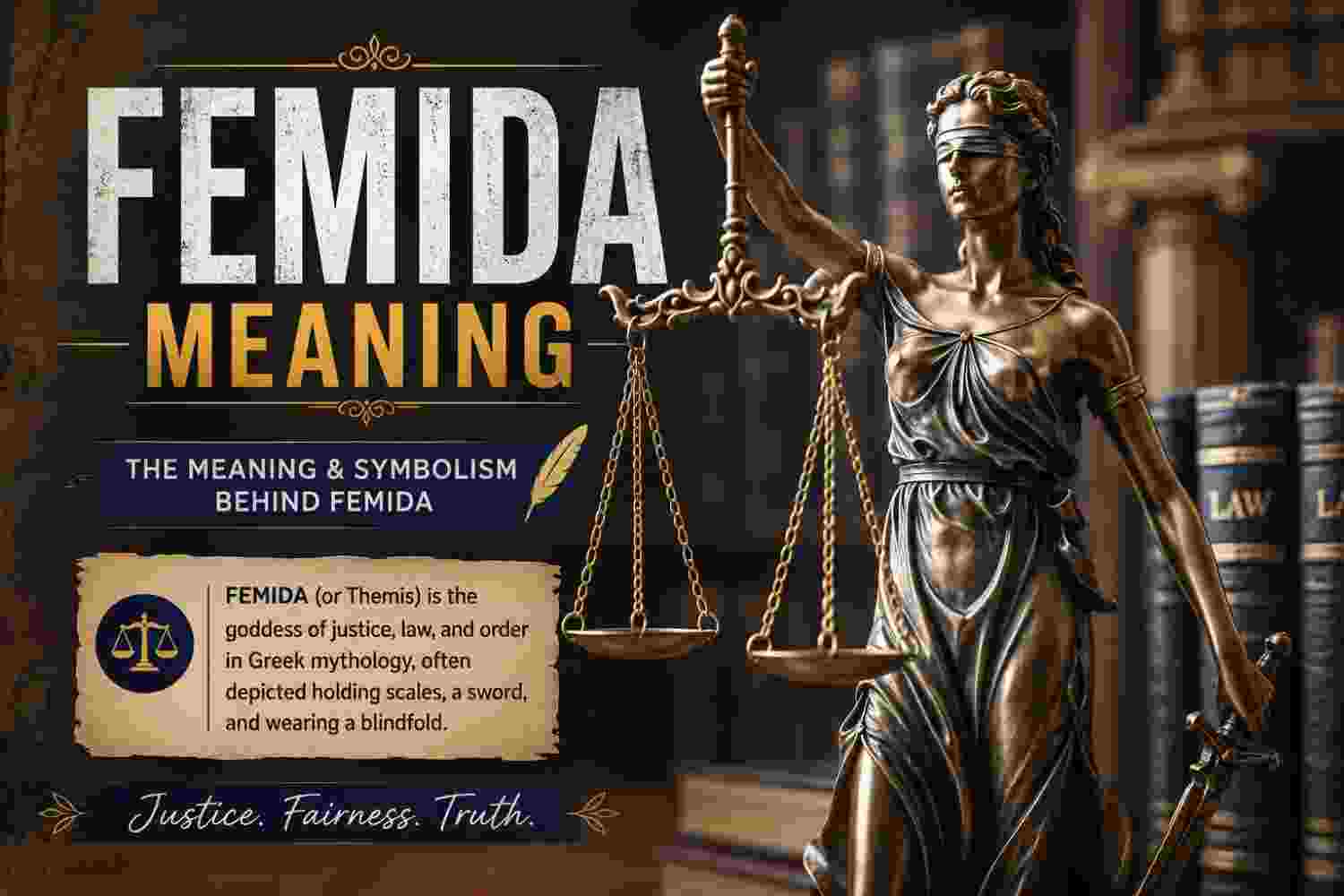
Femida Meaning: The Untold Story Behind This Powerful Name
You searched “femida meaning” expecting a quick one-line answer. What you’ll actually find is a name with two completely different lives — one wrapped in Greek mythology and blindfolded justice, the other rooted in Arabic wisdom and quiet strength.
Most articles online copy-paste the same generic baby-name blurb without explaining where the word truly comes from or why it shows up on courthouse statues across Eastern Europe. This guide fixes that.
By the end, you’ll know exactly which meaning applies to your situation, whether you saw Femida in a legal cartoon, a baby name list, or a Russian news headline.
What Does Femida Actually Mean?
Femida carries two distinct meanings depending on the region and context you encountered it in. It’s not a translation error — both usages are real and widely documented.
Meaning One: The Goddess of Justice
In Russian, Ukrainian, and several Eastern European languages, Femida (Фемида) is the direct phonetic descendant of Themis, the ancient Greek Titaness of law and divine order. She’s the blindfolded woman holding scales that you’ve seen outside courthouses.
- Symbolizes fairness, impartial judgment, and moral order
- Frequently referenced in Russian and Ukrainian legal journalism
- Appears in political cartoons as shorthand for “the justice system”
- Statues and sculptures across post-Soviet countries still use this name
Journalists in Moscow or Kyiv often write phrases like “Femida has spoken” instead of naming a court directly. It’s a stylistic flourish, similar to how English speakers might say “the scales of justice tipped.”
Meaning Two: The Given Name
Separately, Femida exists as a real given name for girls, primarily among Muslim families in South Asia, particularly Pakistan and India. Here, the meaning shifts entirely away from mythology.
- Commonly translated as “Wise” or “Wise woman”
- Rooted in Urdu and Arabic naming traditions
- Associated with intelligence, discernment, and calm judgment
- Occasionally linked to the Arabic root connected to knowledge and understanding
Interestingly, both meanings circle back to the same emotional core — sound judgment. Whether it’s a mythological figure or a newborn daughter, Femida always signals someone trusted to make fair, wise decisions.
Femida vs Themis: Are They the Same Thing?
Short answer: yes, but with a linguistic twist worth understanding. Themis is the original Greek name; Femida is how that name traveled through Byzantine Greek and settled into Slavic pronunciation patterns over centuries.
| Feature | Themis | Femida |
|---|---|---|
| Language origin | Ancient Greek | Slavic adaptation of Greek |
| Common regions | Western Europe, English-speaking countries | Russia, Ukraine, Eastern Europe |
| Symbol | Scales and blindfold | Same symbol, different name |
| Modern usage | Mythology, philosophy | Journalism, legal commentary, statues |
| Given name popularity | Rare | Rare but recognized |
The data shows these aren’t competing names — they’re the same figure wearing different linguistic clothing depending on where the story traveled. Greek influence spread through the Byzantine Empire, and by the time it reached Slavic-speaking regions, “Th” sounds naturally shifted toward “F” sounds, which is exactly how Themis became Femida.
Where You’ve Probably Seen the Word Femida
If you’re not from Eastern Europe or South Asia, you likely stumbled on this word somewhere specific. Here’s where people usually encounter it first.
In News and Political Commentary
Eastern European media outlets use Femida constantly when discussing court rulings, corruption cases, or judicial reform. A headline reading “Femida ignored the evidence” simply means the court overlooked something important.
In Statues and Public Art
Numerous justice statues across Russia, Ukraine, and Kazakhstan are officially labeled Femida rather than Themis. Tourists photographing courthouse architecture often notice the name plaque and search it later.
As a Baby Name
Parents searching baby name databases stumble onto Femida while browsing Muslim girl names starting with “F.” Sites list it alongside names like Fatima, Farah, and Fizza.
In Pop Culture and Games
The search results even show references to a character called “Lady Femida” appearing in online slot games and fortune-themed entertainment, borrowing the justice symbolism for luck-based branding.
Why the Dual Meaning Exists (And Why It Matters)
Names rarely travel cleanly across cultures. When mythology mixes with everyday naming traditions, the original meaning often softens into a personality trait instead of staying tied to a specific goddess.
That’s precisely what happened here. Justice became wisdom. A Titaness became a personal quality parents wanted their daughter to embody. This kind of semantic drift happens with dozens of names worldwide — think of how “Diana” moved from Roman goddess to common first name without most people even connecting the two.
Understanding both threads helps you use the word correctly:
- Writing about law, courts, or Eastern European politics? Use the mythological meaning.
- Discussing baby names or Muslim naming traditions? Use the “wise” meaning.
- Referencing statues or artwork? Almost always the goddess reference.
- Reading a Russian or Ukrainian news article? Assume the justice symbolism unless context says otherwise.
Femida Quick Facts Summary
| Detail | Information |
|---|---|
| Primary meanings | “Justice” (mythological) / “Wise” (given name) |
| Language origins | Greek-Slavic adaptation, Arabic/Urdu |
| Gender association | Feminine |
| Common regions | Russia, Ukraine, Pakistan, India |
| Symbol linked to name | Scales, blindfold |
| Popularity as baby name | Rare |
| Numerology (as reported by naming sites) | Number 2 or 11 depending on source |
Frequently Asked Questions About Femida Meaning
Is Femida a Russian word or a real name?
Both. Femida functions as a common noun-like symbol for “justice” in everyday Russian speech, while also existing as an actual given name in South Asian Muslim communities. The two uses developed independently despite sharing spelling similarities.
Does Femida mean the same as Themis?
Yes, in the Eastern European context. Femida is simply the Slavic phonetic version of the Greek goddess Themis, who represents divine law, order, and impartial justice, complete with the same scales-and-blindfold imagery.
What does Femida mean as a baby girl name?
As a given name, Femida typically means “Wise” or “Wise woman.” It’s popular among Muslim families in Pakistan, India, and surrounding regions, often chosen to reflect hopes for a thoughtful, discerning daughter.
Why do Russian news articles mention Femida so often?
Journalists use Femida as a stylistic stand-in for “the justice system” or “the court,” much like English writers might personify justice poetically. It adds literary weight to legal reporting without repeating “the court” endlessly.
Is Femida a common name today?
No, it remains rare in nearly every region where it’s used, whether as a mythological reference or a given name. Its rarity actually adds to its distinctive, meaningful appeal for parents seeking something uncommon.
Can Femida be used for boys?
Traditionally, no. Both interpretations, the mythological justice figure and the South Asian given name, are exclusively feminine in usage and symbolism across every source examined.
What’s the difference between Femida and Fehmida?
They’re closely related but not identical. Fehmida leans more heavily into Persian and Arabic roots meaning “distinguished” or “worthy of praise,” while Femida more commonly translates to “wise,” though regional spelling variations blur the line between them.
Final Verdict on Femida
Femida isn’t a single-meaning word you can wrap up in one sentence, and that’s actually what makes it interesting. It carries the weight of Greek mythology in one hemisphere and quiet parental hope in another.
If someone asked you right now what Femida means, the honest answer is this: it depends entirely on where you heard it. Context is everything with this one.
Next time you spot the word in a headline or a name list, you’ll know exactly which story it’s telling.