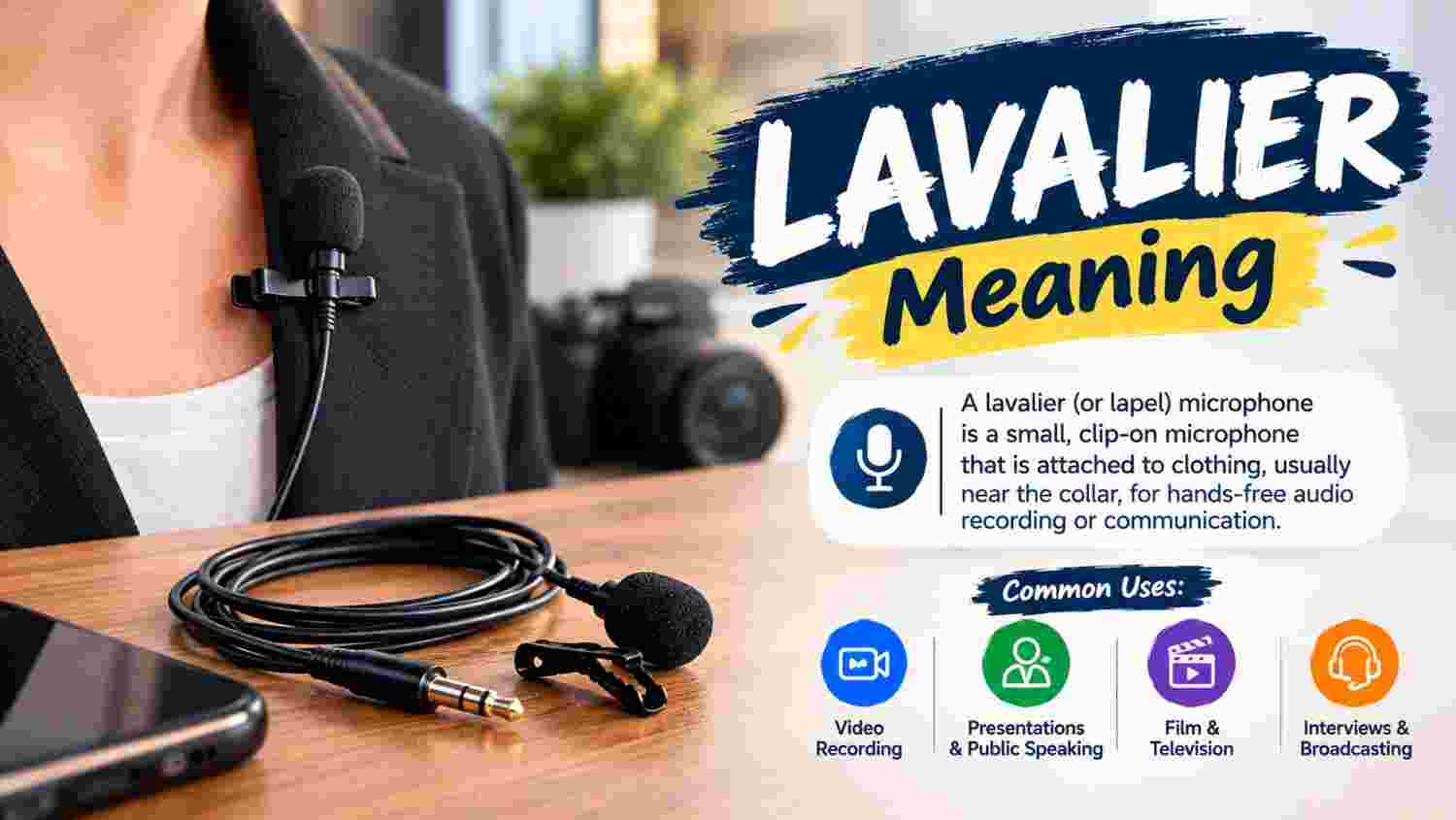
Lavalier Meaning: The Complete Guide to This Tiny Microphone
A tiny microphone clipped neatly to a shirt can make a television interview sound polished, natural, and professional. But what is the lavalier meaning, and why do filmmakers, journalists, teachers, presenters, and social media creators rely on this small audio tool?
In simple terms, a lavalier is a compact microphone worn on a person’s clothing. It sits close to the speaker’s mouth, allowing cameras and recording devices to capture clear speech without requiring the person to hold a microphone. The term is trending because podcasts, video interviews, online courses, livestreams, and short-form videos all depend on clean, hands-free audio.
Unlike a large studio microphone, a lavalier microphone stays mostly out of the frame. That makes it especially useful for celebrity interviews, documentaries, news reports, wedding videos, corporate presentations, and social content where the speaker needs to move naturally.
Quick Information Table
| Category | Details |
|---|---|
| Instagram handle/followers | Not applicable; “lavalier” refers to an audio device, not a celebrity |
| TikTok/X handles | No official account; commonly discussed by creators, videographers, and audio brands |
| Career peak/net worth | Not applicable; the term describes a microphone type |
| Key popularity driver | Hands-free recording for interviews, video content, presentations, podcasts, and live production |
| Common alternative names | Lapel mic, clip-on mic, personal microphone, body-worn microphone |
| Main benefit | Clear speech while keeping the speaker’s hands free |
What Does Lavalier Mean?
The clearest lavalier meaning is “a small microphone designed to be attached to a person’s clothing.” It is usually clipped to a collar, lapel, tie, shirt placket, jacket, or neckline.
The word is often used interchangeably with “lapel microphone.” In practical terms, most people mean the same thing when they say lavalier mic, lapel mic, or clip-on microphone.
A typical lavalier system includes three parts:
- The microphone capsule: This captures the speaker’s voice.
- The cable or transmitter: A wired version sends sound through a cable, while a wireless version sends it to a receiver.
- The recording device or receiver: This may be a camera, smartphone, audio recorder, computer, or mixing console.
The microphone is positioned close to the speaker’s mouth, normally around 15 to 20 centimetres below it. This placement helps produce a stronger and more consistent voice signal than a camera-mounted microphone positioned several feet away.
Where Did the Term Come From?
The history behind the word is connected to jewellery. A lavalier originally referred to a decorative pendant worn around the neck, named after Louise de La Vallière, a famous figure associated with the court of King Louis XIV of France.
Over time, the word became associated with a small item worn around the neck or upper chest. Audio manufacturers later adopted the term for a miniature microphone attached to clothing near the throat or chest.
That history explains why the word can sound unfamiliar to people who have only heard “lapel mic.” In broadcasting and film production, however, “lavalier” has become a standard technical term.
Understanding the lavalier meaning also helps beginners communicate more confidently with camera operators, sound engineers, and production teams. If someone asks whether a presenter needs a lav, they are usually asking whether that person should wear a clip-on microphone.
Lavalier Microphone vs. Handheld Microphone
A handheld microphone is visible and must be held by the speaker or an interviewer. It is common in red-carpet interviews, concerts, press conferences, street reporting, and live events.
A lavalier microphone is smaller and usually hidden or discreetly placed on clothing. It allows the speaker to gesture, hold notes, demonstrate a product, or interact with other people without managing a microphone.
Here is a practical comparison:
| Feature | Lavalier microphone | Handheld microphone |
|---|---|---|
| Visibility | Usually discreet or partly hidden | Clearly visible |
| Hands-free use | Yes | No |
| Best for | Presentations, interviews, tutorials, film | News, live events, stage interviews |
| Sound consistency | Good when positioned correctly | Depends on how it is held |
| Movement | Excellent for natural movement | Limited unless another person holds it |
| Clothing noise risk | Moderate | Very low |
| Setup difficulty | Requires careful clipping and cable management | Usually simple |
| Professional appearance | Clean and unobtrusive | Direct and traditional |
The right choice depends on the setting. A lavalier is usually better when the audience should focus on the person rather than the equipment. A handheld microphone can be better in loud outdoor environments because it is easier to move closer to the speaker’s mouth.
Wired and Wireless Lavalier Microphones
One important part of the lavalier meaning is that a lavalier describes the microphone style, not necessarily the connection type. A lav can be wired or wireless.
Wired Lavalier Microphones
A wired model connects directly to a camera, smartphone, computer, or recorder. It is often affordable, reliable, and easy to use.
The main disadvantage is the cable. If the speaker moves around, the wire may become visible, catch on furniture, or create rubbing noise. Cable management is essential for a clean recording.
Wired models work well for:
- Online teaching
- Desk-based videos
- Interviews in controlled rooms
- Voice recordings
- Presentations near a camera
- Budget-conscious productions
Wireless Lavalier Microphones
A wireless system uses a transmitter attached to the speaker and a receiver connected to the camera or recording device. The speaker can walk around without a long cable running between them and the camera.
Wireless systems are popular in:
- Television interviews
- Weddings
- Documentary work
- YouTube videos
- Corporate events
- Reality programming
- On-location reporting
The trade-off is that wireless systems require batteries or charging. They can also experience interference, connection problems, or signal dropouts if used in crowded radio environments.
How to Wear a Lavalier Microphone Correctly
Learning the lavalier meaning is useful, but correct placement determines whether the recording sounds professional. A high-quality microphone can still produce poor audio if it is clipped too low, covered by fabric, or placed directly against jewellery.
Follow these steps:
1. Choose a Stable Clothing Point
Clip the microphone to a collar, lapel, tie, shirt placket, or jacket edge. The attachment point should not swing or rub heavily against the fabric.
Avoid loose scarves, thin chains, necklaces, and highly textured clothing whenever possible. These surfaces can create distracting clicking and scraping sounds.
2. Position It Near the Upper Chest
Place the microphone roughly 15 to 20 centimetres below the mouth. If it is too close, the voice may sound boomy or overloaded. If it is too far away, the recording may sound quiet and distant.
The microphone should point toward the speaker’s mouth. Some models are designed to face upward, while others have a specific front side that must face the voice.
3. Secure the Cable
Run the cable under a shirt, jacket, or scarf when appropriate. Leave a small loop near the microphone to reduce tension and prevent every movement from pulling on the capsule.
Do not stretch the cable tightly. A relaxed cable is less likely to transmit clothing noise.
4. Add a Wind Cover When Needed
Foam covers help reduce breath noise and light air movement. For outdoor recording, a furry windscreen may be necessary, especially when the speaker is standing near traffic, fans, or open spaces.
5. Perform a Sound Check
Ask the speaker to talk at a natural volume while walking, turning the head, and moving the arms. Listen for rubbing, crackling, clipping, weak volume, and sudden changes in tone.
A 30-second test can prevent an entire interview from becoming unusable.
Common Lavalier Mistakes to Avoid
Many beginners misunderstand the lavalier meaning and assume that simply attaching the microphone guarantees good sound. Placement and environment matter just as much as the device itself.
Clipping It Too Low
A microphone placed near the stomach or lower chest will capture more room sound and less direct speech. The result may be thin, distant, or echo-filled.
Hiding It Under Heavy Fabric
Thick clothing can muffle the voice. It can also create friction every time the speaker moves. When concealment is necessary, use professional mounting techniques and test the result carefully.
Placing It Against Jewellery
Necklaces, pendants, zippers, and buttons can strike the microphone capsule. Even tiny movements may become loud in the recording.
Ignoring Background Noise
A lavalier captures the speaker clearly, but it does not magically remove traffic, air conditioners, fans, crowds, or construction. Choose the quietest practical location before recording.
Speaking Directly Into the Microphone
The speaker should not turn the head dramatically toward the microphone or touch it while talking. Normal movement is fine, but the capsule should remain stable.
Forgetting Battery Checks
Wireless transmitters and receivers may look connected even when the battery is nearly empty. Check battery levels before every important shoot.
Why Lavalier Microphones Matter in Entertainment
The entertainment industry helped make the lavalier microphone familiar to the public. In celebrity interviews, a small clip-on microphone allows performers to speak naturally while maintaining eye contact with the host or camera.
Reality television also depends heavily on body-worn microphones. Participants can move through a house, kitchen, studio, or outdoor location while production teams capture their conversations.
Behind the scenes, sound teams often use multiple microphones at once. A person may wear a lavalier while a boom operator records a second track. Having two sources gives editors more flexibility if one microphone picks up clothing noise or signal problems.
The lavalier meaning matters in this context because the device is not merely a convenience. It is part of a larger production system designed to keep dialogue understandable and emotionally believable.
Lavalier Microphones for Social Media Creators
Short-form video has made wireless lavalier systems especially popular. Creators use them for product reviews, beauty tutorials, cooking videos, fitness demonstrations, street interviews, travel content, and educational clips.
The main attraction is speed. A creator can attach a transmitter, connect a receiver to a phone, and begin recording without setting up a large microphone stand.
For creators, a lavalier can improve:
- Voice clarity
- Viewer retention
- Outdoor recording quality
- Walking-and-talking videos
- Two-person interviews
- Product demonstrations
- Tutorial narration
- Live broadcasts
Audio quality often affects how professional a video feels. Viewers may forgive simple lighting or an ordinary background, but muffled speech and loud wind can make them leave quickly.
Product and Setup Comparison Table
| Setup | Approximate cost level | Best use | Main advantage | Main limitation |
|---|---|---|---|---|
| Basic wired lavalier | Low | Phone videos and online classes | Affordable and dependable | Cable can restrict movement |
| Premium wired lavalier | Medium | Interviews and presentations | Better tonal detail and build quality | Still requires cable management |
| Single wireless lavalier | Medium | Solo creators and presenters | Hands-free movement | Requires charging |
| Dual wireless system | Medium to high | Two-person interviews | Records two speakers separately | More complex setup |
| Professional broadcast lavalier | High | Film, television, and live production | Strong durability and sound quality | Expensive for casual users |
| Smartphone-compatible lavalier | Low to medium | Reels, TikTok, and mobile video | Simple phone connection | Compatibility varies by device |
The best choice depends on how and where you record. A beginner filming seated videos does not necessarily need a costly broadcast system. A documentary crew working outdoors may need stronger wireless range, replaceable parts, and dependable backup options.
Expert Advice for Better Lavalier Audio
Audio professionals often focus on three principles: placement, protection, and monitoring.
First, place the microphone consistently. The same distance from the mouth produces a more stable voice level throughout the recording.
Second, protect the capsule from wind and clothing movement. A small piece of soft mounting tape, a proper clip, or a concealed cable loop can make a major difference.
Third, monitor the recording whenever possible. Use headphones to listen for problems that may not be obvious on a camera’s small screen. Check the signal before the interview begins and again if the speaker changes clothing or location.
For a polished interview, record a few seconds of room tone after the conversation. Editors can use this quiet background sound to smooth transitions and reduce sudden changes in ambience.
Frequently Asked Questions
What is the exact lavalier meaning?
The term refers to a small microphone attached to a person’s clothing, usually near the upper chest. It is also commonly called a lapel microphone or clip-on microphone.
Is a lavalier microphone the same as a lapel mic?
In most everyday situations, yes. “Lavalier” is the more technical or production-focused term, while “lapel mic” is widely used by presenters, creators, and general audiences.
Are wireless lavalier microphones better than wired ones?
Wireless models provide greater freedom of movement, but wired models are often simpler, cheaper, and less vulnerable to battery or signal problems. The better option depends on the location, budget, and type of recording.
Where should a lavalier microphone be placed?
It should normally sit around 15 to 20 centimetres below the speaker’s mouth, attached securely to a collar, lapel, tie, or shirt placket. Keep it away from jewellery, loose fabric, and anything that may rub against the capsule.
The Simple Takeaway
The lavalier meaning is easy to remember: it is a small, wearable microphone made for hands-free speech recording. Its discreet design makes it useful for television, film, journalism, online education, presentations, podcasts, livestreams, and social media.
The best results come from careful placement, secure cable management, wind protection, and a proper sound check. Whether you are filming a celebrity interview or recording a simple phone tutorial, the right lavalier setup can make the speaker sound closer, clearer, and more professional.