Mahalo Meaning: The Real Story Behind Hawaii’s Most Famous Word
Walk through any airport in Honolulu and you’ll hear it within minutes. It’s printed on trash can lids, stitched into hotel towels, and spoken by every local who hands you a plate lunch — yet most visitors never learn what it actually carries.
Here’s the secret: mahalo meaning goes far deeper than a simple “thank you.” It’s a small window into how Hawaiians view breath, presence, and human connection. By the end of this guide, you’ll know how to pronounce it, when to use it, how to answer it, and the surprising reason it shows up on garbage bins.
What Does Mahalo Mean, Exactly?
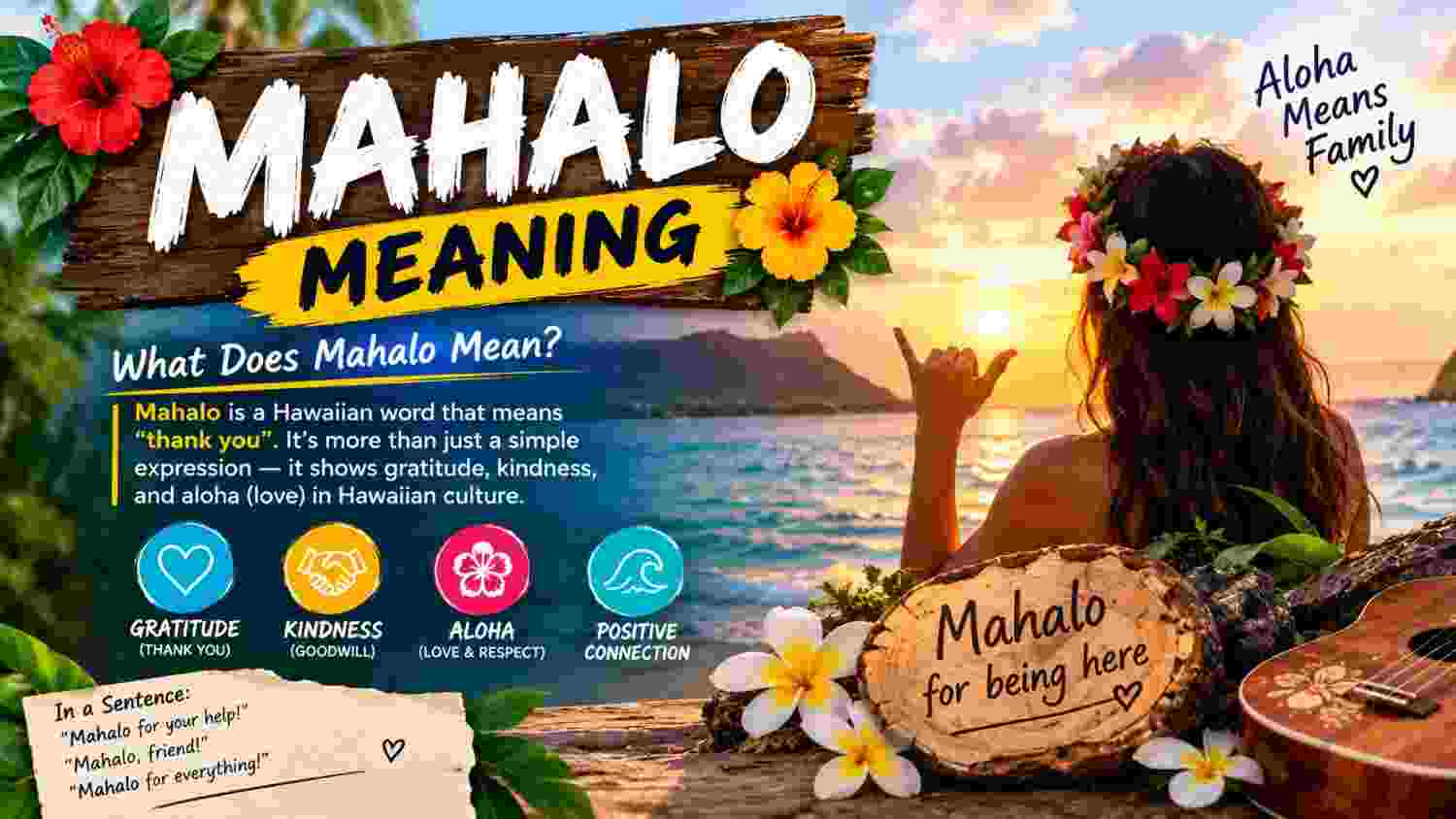
The short answer: mahalo is the Hawaiian word for gratitude, thanks, and admiration. Locals say it after receiving a lei, a kind favor, or even a warm smile from a stranger.
But treat it as just a transaction and you’ll miss the point. In Hawaiian culture, saying mahalo is a moment of recognition. You’re acknowledging that someone gave part of themselves to you, however small.
That’s why the word lands differently when a local says it slowly, with eye contact, instead of tossing it out like a reflex. The feeling travels with the sound.
How to Pronounce Mahalo
Pronounce it mah-HAH-loh, with the stress on the middle syllable. All three vowels are pure and short, and Hawaiian never hides a letter — every sound you see gets spoken.
- ma — like “ma” in mama
- ha — like the start of “hot,” and this syllable gets the punch
- lo — like “low”
Say it in one smooth rhythm and you’ll fit right in at a luau. Rush it into “ma-HAY-loh” and you’ll instantly sound like a first-day visitor.
One Word With Many Everyday Uses
- Thanking a server, driver, or shopkeeper
- Showing respect after receiving a gift or lei
- Closing an email or conversation on a warm note
- Expressing admiration, not just thanks — mahalo can honor something beautiful, not only something given
The Deeper Roots of the Mahalo Meaning
Hawaiian is a language built from nature. Words often carry layers of imagery, and mahalo is a perfect example.
Breaking Down Ma, Ha, and Alo
Many kupuna (Hawaiian elders) explain the word through its parts. Ma suggests being within or in relation to something. Ha means breath — the same breath of life found in aloha. Alo points to presence, face, or front.
Read together, mahalo becomes something like “sharing the breath of life in someone’s presence.” That’s a long way from a polite phrase tossed at a cashier.
Linguists track the word to older Polynesian roots for gratitude and praise, and you can hear cousins of it across the Pacific. In Tongan, mālō also expresses thanks and approval. One ocean, one family of words.
How Mahalo Connects to the Aloha Spirit
Mahalo lives inside the same value system as aloha — love, peace, and mutual regard. Hawaii even wrote those values into law. The Aloha Spirit Law of 1986 asks state officials and residents to treat others with the same care the word implies.
So when someone says mahalo to you, they’re practicing a cultural habit, not reciting a script. Returning that energy is the whole game.
How Locals Use Mahalo (And How You Can Too)
You don’t need to be Hawaiian to use the word, and locals genuinely appreciate hearing it from visitors who try. A little effort earns a lot of warmth.
- Say it when someone helps you — directions, a recommendation, a refill.
- Say it when receiving something physical: a lei, food, a gift.
- Slow down when you say it. Speed kills sincerity.
- Pair it with a nod or eye contact.
- Save mahalo nui loa for moments when someone truly went out of their way.
When Not to Force It
Skip it if you’re going to repeat it ten times in one hour. Scattered, rapid-fire mahalos start to sound like background noise. One honest mahalo beats five hollow ones every single day.
How to Respond When Someone Says Mahalo
The classic reply is ʻaʻole pilikia, pronounced ah-oh-leh pee-LEE-kee-ah. It translates to “no problem” or “no trouble.”
You can also simply smile and say mahalo right back. Gratitude, in Hawaiian culture, tends to travel in circles rather than straight lines.
Mahalo Phrases Worth Knowing
A few variations stretch the word across almost every situation you’ll meet on the islands.
| Hawaiian Phrase | English Meaning | When to Use It |
|---|---|---|
| Mahalo | Thank you | Everyday gratitude |
| Mahalo nui | Thank you very much | For bigger favors |
| Mahalo nui loa | Deepest thanks of all | Heartfelt, meaningful moments |
| Mahalo iā ʻoe | Thank you (to one person) | Direct, personal thanks |
| Mahalo i ke Akua | Thanks be to God | Spiritual gratitude and blessings |
| ʻAʻole pilikia | No problem / you’re welcome | The standard reply to mahalo |
Notice how the phrase grows as the emotion grows. Adding nui (big) and then loa (very, longest) is Hawaiian’s way of turning up the volume on your heart, not your voice.
The Numbers Behind the Language
The story of mahalo is also the story of the language that carries it — a language that nearly disappeared and fought its way back.
| Hawaiian Language Fact | Figure |
|---|---|
| Letters in the Hawaiian alphabet | 13 (including the ʻokina) |
| People speaking Hawaiian at home | ~18,600 (U.S. Census estimates) |
| Estimated native speakers | ~2,000 |
| Hawaiian became an official state language | 1978 |
| First Pūnana Leo immersion preschool | 1984 |
| UNESCO status | Critically endangered |
Look at those numbers and one thing stands out. A word spoken by millions of tourists each year comes from a language with only a few thousand native speakers. Every time a visitor uses mahalo with respect, they help pull the language a little further from the endangered list.
Why Does “Mahalo” Appear on Trash Cans?
Here’s the joke every local loves telling newcomers. Tourists see mahalo printed on garbage cans all over the islands and assume the word means “trash.”
It doesn’t, of course. Bins carry the word as a thank-you for keeping the land clean — a nod to mālama ʻāina, the Hawaiian duty to care for the land that cares for you. The label is gratitude, not a label for garbage.
The mix-up makes a great story to retell over dinner, and it proves one thing: words travel further than their meanings unless someone bothers to explain them. Which is exactly why you’re reading this.
Mahalo vs. Aloha vs. ʻOhana: A Quick Comparison
These three words get tangled up by visitors constantly. Here’s how to keep them straight:
- Aloha — hello, goodbye, and love; about presence and shared breath
- Mahalo — gratitude; the response to kindness or beauty
- ʻOhana — family, including the family you choose
- Mālama — to care for and protect, as in mālama ʻāina (care for the land)
Think of aloha as the greeting that opens a relationship, mahalo as the gratitude that keeps it healthy, and ʻohana as what the relationship can become.
Frequently Asked Questions About Mahalo Meaning
What does mahalo mean in English?
Mahalo means “thank you,” gratitude, and admiration in Hawaiian. It’s used the way English speakers use “thanks,” but it carries a deeper sense of honoring the person who helped you.
How do you pronounce mahalo correctly?
Say mah-HAH-loh, with the emphasis on the second syllable. Keep each vowel short and clear, and never skip the final “o” sound.
What is the proper reply to mahalo?
Answer with ʻaʻole pilikia (ah-oh-leh pee-LEE-kee-ah), which means “no problem.” A smile and a returned mahalo also work perfectly.
What does mahalo nui loa mean?
It means “thank you very much,” or more literally, “great thanks, the longest.” Locals reserve it for genuine, heartfelt gratitude — the kind you feel when someone goes far out of their way for you.
Is mahalo related to aloha?
Yes, in spirit and structure. Both share the ha (breath) and alo (presence) idea, tying gratitude and love to one Hawaiian belief: sharing breath is sharing life.
Why is mahalo written on garbage cans in Hawaii?
It’s a thank-you message for disposing of trash properly, connected to caring for the land. It does not mean “trash” — that’s a beloved myth locals enjoy correcting.
Are there similar words in other Polynesian languages?
Yes. Tongan uses mālō for thanks and praise, traced back to the same ancestral Polynesian roots. The Pacific islands speak in cousins.
Final Word: Say It Like You Mean It
Here’s the insider tip most travel blogs skip: mahalo works best when it’s slightly underused. Say it once, say it slowly, and mean it. The word rewards intention.
On your next trip — or even in an email to a friend who helped you move — try opening with a genuine mahalo. You’re not borrowing a souvenir. You’re participating in one of the oldest living traditions of gratitude in the Pacific.
And the next time someone hands you a plate of kalua pig with a smile, you’ll know exactly what to say, and exactly why it matters.