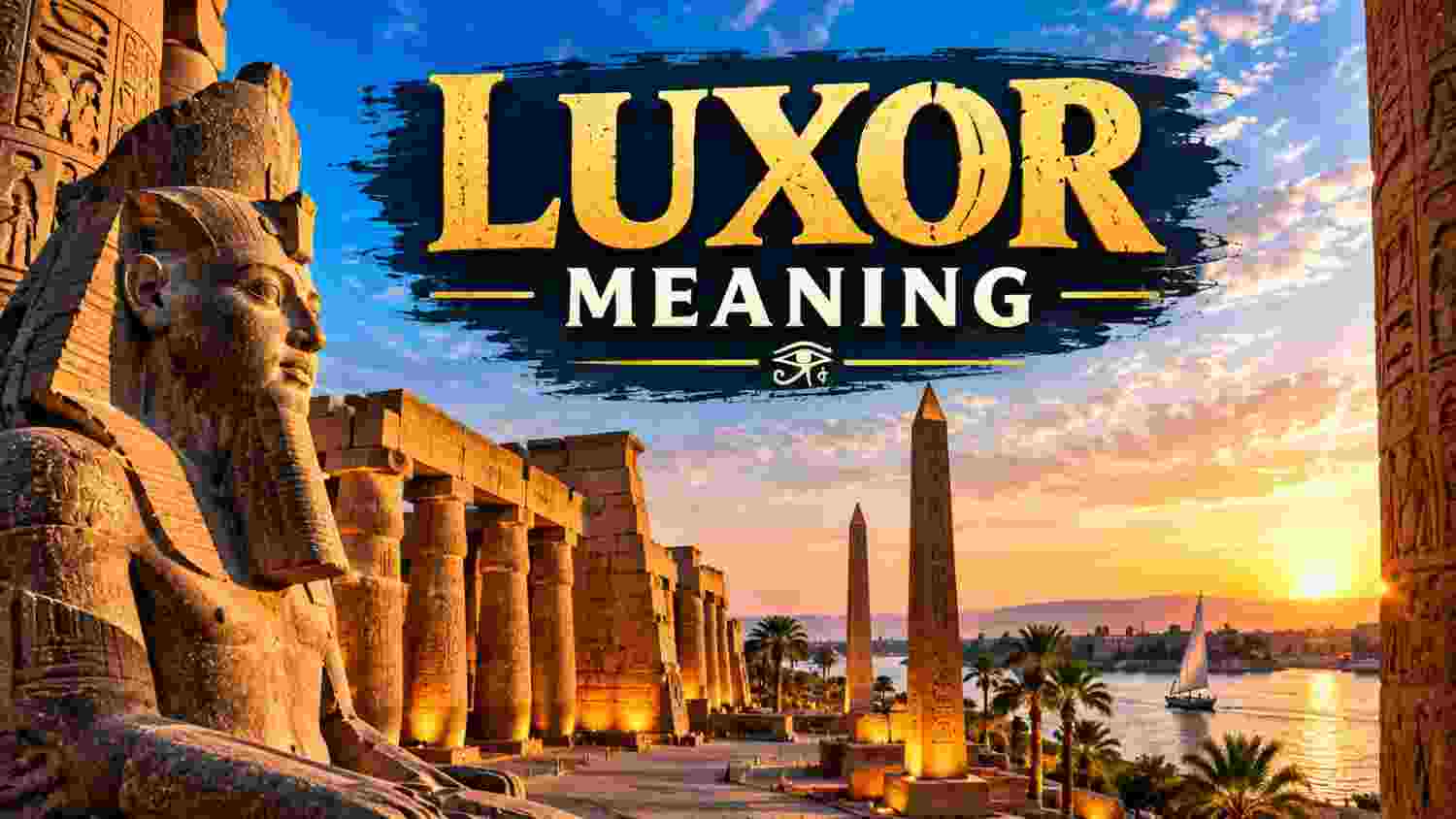
Luxor Meaning: The Real Story Behind the Name Everyone Asks About
You have probably typed “luxor meaning” into Google after hearing it in a movie, a travel vlog, or a conversation about Las Vegas. Maybe a friend just came back from Egypt with photos of glowing temples and giant columns, and you nodded along without fully knowing what the name stood for.
Here is the truth: the word points to palaces, kings, and one of the greatest open-air museums on Earth.
By the end of this piece, you will know the exact origin of the word, the two famous places that share it, and a handful of facts you can drop into any conversation.
What Does “Luxor” Actually Mean?
The short answer is simple. Luxor means “the palaces” or “the fortresses.”
It comes from the Arabic name al-Uqsur, which translates directly to “the palaces” or “the camps.” Early Arab travelers looked at the massive remains of Egyptian temples and saw what they believed were ancient royal palaces, so the name stuck.
The root word is qasr, meaning palace or castle. Arabic borrowed that term from the Latin castrum, which referred to a fortified military camp.
So when you say “Luxor,” you are literally saying “the place of the palaces.”
The Arabic Roots of the Word
Language lovers will enjoy this one.
Al-Uqsur is a plural form, so the name describes not one palace but many. That fits the region perfectly, because Luxor sits on top of layers and layers of royal structures.
Here is how the word evolved over the centuries:
- Latin castrum gave the world the idea of a fort or military camp.
- Arabic adopted it as qasr, meaning palace or castle.
- The plural uqsur described the many grand ruins along the Nile.
- European travelers softened the sound into the modern spelling “Luxor.”
From Waset to Thebes to Luxor
The city did not always carry this name.
Long before Arabic speakers arrived, ancient Egyptians called the area Waset, meaning “City of the Scepter.” The Greeks later renamed it Thebes, a name many people still recognize from Homer’s poems and Greek legends.
Only after the Arab conquest of Egypt did al-Uqsur appear, and that eventually became the Luxor we use today.
So a single city has lived under three different names across its long history, and each one reflects a different era of power.
Why Luxor Carries So Much Historical Weight
Ask any Egyptologist to name the most important ancient city, and Luxor usually tops the list.
The city stands on the east bank of the Nile in Upper Egypt, roughly 670 kilometers south of Cairo. It holds the ruins of Thebes, which served as Egypt’s capital during the New Kingdom, the golden age of pharaohs like Tutankhamun and Ramses II.
People often call Luxor the world’s greatest open-air museum, and the title is earned. Walk a few blocks and you pass temples, tombs, and statues that most museums would fight to display indoors.
The Monuments That Define the Name
When early Arabs saw those ruins, they were looking at places you can still visit today.
- Karnak Temple: A sprawling complex that pharaohs built and expanded for over 2,000 years.
- Luxor Temple: The monument that gave the city its modern name, standing right in the center.
- Valley of the Kings: The hidden burial ground of pharaohs, including Tutankhamun’s tomb.
- Valley of the Queens: The resting place for royal wives and princes.
- Hatshepsut’s Temple: A terraced masterpiece carved straight into the desert cliffs.
Each site adds another layer to what the name “the palaces” truly represents.
A Quick Look at the Numbers
The scale of Luxor surprises most first-time visitors. Here is a snapshot:
| Fact | Detail |
|---|---|
| Ancient capital name | Thebes (Waset to the Egyptians) |
| Distance from Cairo | About 670 km to the south |
| Karnak’s construction span | Roughly 2,000 years |
| Tutankhamun’s tomb | Found in 1922 in the Valley of the Kings |
| Modern population | Around 500,000+ residents |
These numbers show why the word “palaces” fits so well. Few places on Earth pack this much history into a single city.
The Other Luxor: Las Vegas and Pop Culture
Mention Luxor in America, and most people picture a giant black pyramid with a beam of light shooting into the sky.
The Luxor Hotel and Casino opened on the Las Vegas Strip in 1993. Its design borrows heavily from Egypt’s imagery, with a 30-story pyramid, a giant sphinx, and an obelisk out front.
That light beam at the top ranks among the strongest in the world. Pilots reportedly spot it from hundreds of kilometers away, and it made the casino an instant landmark.
Why the Brand Chose the Name
The owners picked the name for one simple reason: prestige.
Egypt, and Luxor especially, represents mystery, wealth, and ancient luxury in popular culture. Put that name on a casino and you instantly sell an experience of golden opulence.
The branding worked so well that many people today know the Vegas pyramid better than the actual Egyptian city.
Luxor in Games and Media
The name also pops up constantly in entertainment.
- The Luxor puzzle game series, where players shoot colored balls at moving chains.
- Countless films and documentaries set among the real city’s temples.
- Travel shows that use Luxor as shorthand for ancient Egypt itself.
Every mention traces back to the same root meaning: palaces, power, and a touch of mystery.
Why People Search “Luxor Meaning” Today
Searches for “luxor meaning” spike every single year, and the reasons are more practical than you might think.
Some people are planning a trip to Egypt and want to understand the places they will visit. Others saw the Vegas pyramid and got curious about the name. A smaller group just wants to settle a trivia argument.
The search also climbs whenever a new documentary or video game featuring Egypt drops, because curiosity always follows attention.
Whatever brought you here, the word now means more than it did a few minutes ago.
Quick Facts You Can Drop Anywhere
Here are seven facts that sum up the whole story in seconds:
- Luxor comes from Arabic al-Uqsur, meaning “the palaces.”
- Ancient Egyptians called the city Waset, while the Greeks called it Thebes.
- The root qasr traces back to Latin castrum, a military fort.
- Luxor sits about 670 km south of modern Cairo.
- It holds the Valley of the Kings, where Tutankhamun was found.
- A Las Vegas casino-hotel named Luxor opened in 1993.
- The Vegas Luxor’s sky beam is among the strongest lights on Earth.
Frequently Asked Questions
What does the word Luxor mean in English?
Luxor means “the palaces” or “the fortresses.” It comes from the Arabic name al-Uqsur, which early travelers used to describe the grand temple ruins they found along the Nile in Upper Egypt.
Is Luxor the same as Thebes?
Yes. Luxor is the modern name for the ancient city of Thebes. Before the Greeks called it Thebes, Egyptians knew it as Waset, and the modern Arabic name replaced both over time.
Why is Luxor so famous?
Luxor is famous because it holds an unmatched collection of ancient monuments, including Karnak Temple, Luxor Temple, and the Valley of the Kings. Many people call it the world’s largest open-air museum.
What is the Luxor hotel in Las Vegas?
The Luxor is a casino-hotel on the Las Vegas Strip that opened in 1993. It is shaped like a giant pyramid and features a sphinx, an obelisk, and a sky beam visible from great distances.
How do you pronounce Luxor?
Most English speakers say “LUK-sor,” with the stress on the first syllable. The Arabic original, al-Uqsur, sounds closer to “al-OOK-soor.”
Is Luxor safe for tourists?
Luxor is generally considered safe and welcoming for tourists, and the local economy depends heavily on tourism. Standard travel precautions apply, and many visitors explore it with local guides.
What should I visit first in Luxor?
Start with Luxor Temple and Karnak Temple on the east bank, then cross to the west bank for the Valley of the Kings. Two full days give you a solid first taste of the city.
The Final Verdict
The word means “the palaces,” a name Arab travelers gave to ruins so grand they could only imagine them as royal homes. Behind that name sits a city that ruled an empire, buried its kings in golden tombs, and later lent its mystery to a Vegas casino.
Insider tip: if you visit Egypt, book a sunrise balloon ride over the west bank. Seeing the palaces from the sky is the one memory that will finally make the word feel real.