What Makes an Online Multiplayer Social Deduction Game So Addictive?
You join a lobby with nine strangers. Two of them are lying to your face, and your only weapon is conversation. One wrong vote and your team loses — again. That sting is exactly why an online multiplayer social deduction game keeps pulling players back night after night. This guide hands you the history, the mechanics, the psychology and the tactics that turn confused newcomers into the player everyone trusts.
What Is an Online Multiplayer Social Deduction Game?
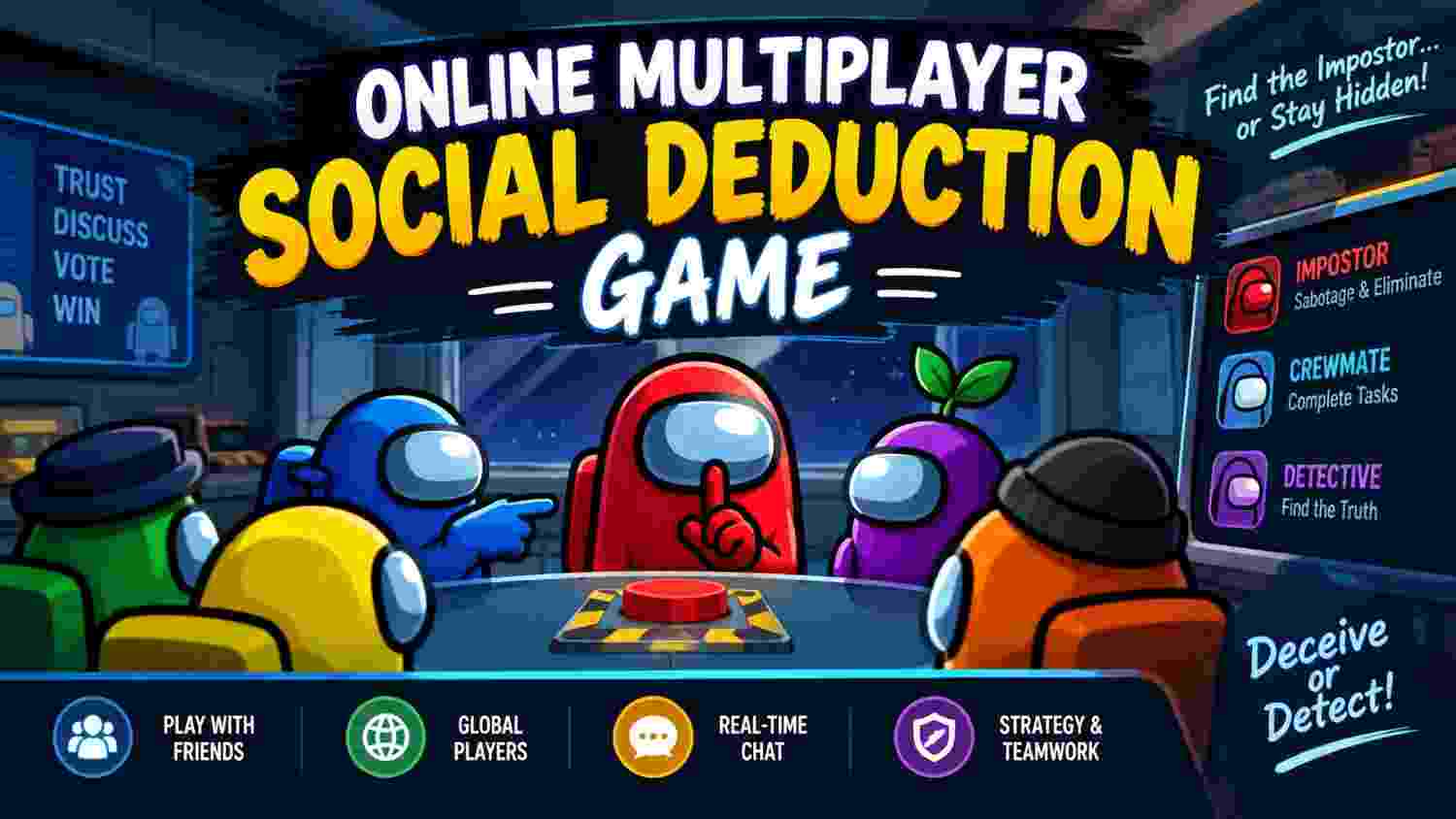
An online multiplayer social deduction game is a hidden-role contest where a small, secret minority works against an uninformed majority. The informed team knows everyone’s identity. The uninformed team knows nothing except what people say.
Victory in an online multiplayer social deduction game never comes from reflexes. It comes from arguing well, reading hesitation, and deciding who deserves your vote.
Three ingredients define the genre:
- Hidden information — roles are dealt secretly at game start.
- Open discussion — players talk, accuse and defend through voice or text chat.
- A binding vote — the group eliminates someone, right or wrong, and lives with it.
Who Invented Social Deduction, and Why Does It Matter?
Psychology student Dmitry Davidoff created Mafia at Moscow State University in 1986 as a classroom experiment about informed minorities versus uninformed majorities. Students played it in dorm hallways; the rules spread through word of mouth across Europe and then the world.
Andrew Plotkin reskinned it as Werewolf in 1997, swapping gangsters for folklore and tightening the night phase. Every modern online multiplayer social deduction game — from Among Us to Blood on the Clocktower — inherits that 1986 skeleton.
That lineage matters for one reason: the genre was designed by a psychologist to study human deception, not by a studio chasing engagement metrics. The tension is authentic.
Creator Profile: Dmitry Davidoff — Childhood to Present
| Life Stage | What Happened |
| Early childhood (1960s, USSR) | Born and raised in Moscow during the Soviet era; grew up in a household where card games and parlour word games filled long winters. |
| School years | Showed early interest in group behaviour, debate and puzzle-solving rather than competitive sport. |
| University (1980s) | Enrolled at Moscow State University’s Faculty of Psychology, studying group dynamics and conflict resolution. |
| 1986 — the breakthrough | Designed Mafia as a teaching tool to demonstrate how an informed minority can defeat an uninformed majority. First played with his own psychology students. |
| Late 1980s | Game spread through MSU dorms, then to summer camps and student clubs across the Soviet Union. |
| 1990s | Mafia crossed borders with travelling students; variants appeared in Europe, Israel and the United States. Andrew Plotkin released the Werewolf reskin in 1997. |
| 2000s | Davidoff continued working in psychology and game facilitation, running live Mafia sessions and advising on rule variants as televised and club play exploded in Russia. |
| 2010s | Recognised publicly as the genre’s originator while digital adaptations (Town of Salem, Werewolf apps) carried the format online. |
| 2018–2020s | Among Us turned his classroom idea into a global phenomenon; Davidoff is widely credited in press coverage and game-design literature as the father of social deduction. |
| Present day | Lives in Russia, still associated with Mafia culture and club play; his 1986 ruleset remains the structural blueprint for nearly every online multiplayer social deduction game shipping today. |
Which Titles Define the Genre Right Now?
Use this profile table to pick your first lobby.
| Game | Studio / Creator | Launch | Players | Platforms | Best For |
| Among Us | Innersloth | 2018 | 4–15 | PC, mobile, console | Beginners; fast 10-minute rounds |
| Goose Goose Duck | Gaggle Studios | 2021 | 3–16 | PC, mobile | Big lobbies, proximity voice chat |
| Town of Salem 2 | BlankMediaGames | 2023 | 8–15 | PC | Deep role lists and text argument |
| Secret Hitler (digital) | Community / Goat Wolf & Cabbage | 2016 | 5–10 | Browser | Political bluffing, no hidden tasks |
| Blood on the Clocktower | The Pandemonium Institute | 2022 | 5–20 | Tabletop + online tools | Experts; dead players keep playing |
| Werewolf (app versions) | Various | Ongoing | 7–20 | Browser, mobile | Purist, discussion-only play |
Each entry is a legitimate online multiplayer social deduction game, but they reward different skills — Among Us rewards movement tracking, Secret Hitler rewards policy logic, Clocktower rewards information auditing.
Why Does Social Deduction Feel So Emotionally Intense?
Lying to friends activates something ordinary shooters never touch. You are managing reputation, not just a scoreboard.
Three psychological levers do the work:
- Loss aversion — a wrong vote costs the whole team, so every opinion carries weight.
- Social risk — being accused feels personal even when it is random.
- Reward uncertainty — you never know if your read was skill or luck, which keeps you playing “one more round”.
Researchers studying trust games have long noted that uncertainty plus social stakes produces stronger engagement than pure competition. A good online multiplayer social deduction game weaponises exactly that.
What Skills Separate Good Players From Great Ones?
Great players do four things consistently:
- Timestamp everything. “I was in electrical at the 40-second sabotage” is superior to “I was busy.”
- Track silence. Quiet players are either lost or hiding. Ask them a direct question.
- Commit to a read. Fence-sitters get voted out because nobody can verify them.
- Stay consistent. Changing your story mid-meeting is the loudest tell in the genre.
Confidence beats cleverness in every online multiplayer social deduction game. A clear, boring, verifiable account survives more votes than a brilliant theory.
Quick Comparison: Which Game Fits Your Group?
| Your Group | Pick This | Why |
| Total beginners | Among Us | Simple roles, visual tasks |
| Large friend group (12+) | Goose Goose Duck | Scales well, free |
| Debate lovers | Secret Hitler | Pure argument, no tasks |
| Text-chat players | Town of Salem 2 | Written cases reward detail |
| Veterans wanting depth | Blood on the Clocktower | Dead players stay involved |
Your Next Lobby Starts Now
The fastest way to improve is to play five rounds tonight and keep notes on every vote you got wrong. Pick one title from the table, invite four friends, and host a private lobby. You will lose early and read people better by round three — that is how the genre teaches. Share this guide with the friend who always votes last, then go win something.
🎮 Want More Guides?
Explore more tips, codes, patches and gaming guides in our Blog Arena.
▶ Browse All Quests